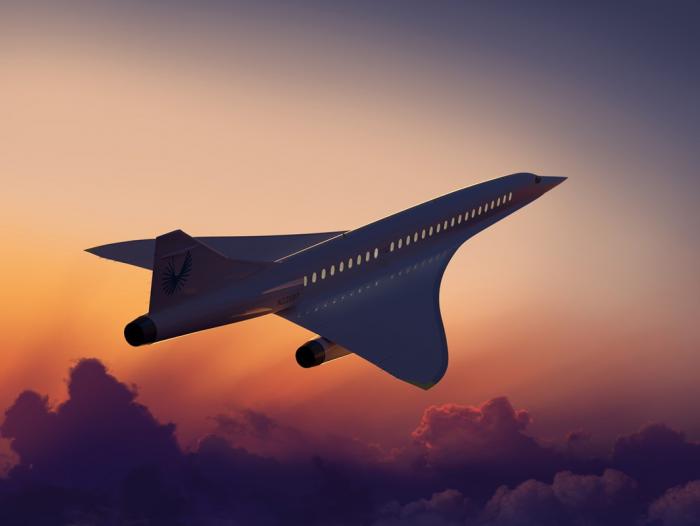
And the future of aeronautics continues to open up new possibilities.
In the previous post we talked about the evolution of the Concorde, as well as its cancellation and the very likely resurgence in the next decade of the Overture, another supersonic aircraft of the Boom Supersonic company that plans to have its first tests after 2025.
However, not everything in this aviation race is about being faster. It also seeks to reduce costs, consuming less fuel and, therefore, polluting less.
Finally, the air transport economy seems to shed some hope in the coming years.
An important aspect in aeronautics is that there are more people researching to reduce consumption and be able to use other forms of energy, because a serious problem for electric aircraft is that, with energy chargers, there is no space left even for passengers.
That is why finding a reduction in fuel consumption is a priority.
To do this, there is an airplane that has set its sights on fuel saving above all else, and plans to revolutionize the market.
It is the Jumbo Jet SE200 from SE Aeronautics, which is of a disruptive design with the following characteristics:
- It has three pairs of wings
- It has a doble rear fin
- Includes two back engines
- It will be able to carry 264 passengers
- It is estimated to fly up to 10,500 miles
- Its speed is planned to be comparable to that of current aircrafts; and the cherry on top…
- It will consume 70% less fuel than the average!
Another peculiarity is that, with the design of its wings, it has the ability to have short take offs and landings, which gives it great scope to interact with smaller airports compared to other aircraft of the same dimensions.
It has other novelties, such as the place where it stores fuel. It will no longer be on the wings like other airplanes, but on the top of the fuselage.
This allows the wings to be much thinner and more aerodynamic, with which the SE200 improves its ability for short landings as already mentioned.
Also, another of its secret ingredients will be the fuselage frame of one piece or monocoque, with lighter materials. Thus giving it a useful life of 50 years.
Current traditional airplanes are screwed in many parts, which makes them more susceptible to detachments or break-ups.
On the other hand, one of the points that do not entirely favor the SE200 is the ability to only accommodate 264 passengers, compared to the 853 that fit in the Airbus A380 (the largest commercial airplane in the world).
But it’s a start.
In addition, with the CO2 reductions proposed by this jumbo, it has all to gain from the generations that follow.
As if that weren’t enough, the SE200, in addition to its range, speed, payload, safety and passenger-mile per gallon and the tons-miles per gallon, it will be able to be built in less than half the time it takes to regularly build an aircraft of the same size.
Thus, appreciable customers and readers, Crossdock, as specialists in supply chain consulting, we see ourselves with the compromise to inform all of you of the ins and outs of the world of aviation.
And in the next installments we will also address the issue of the future of maritime and rail transport.
Well, Crossdock delivers. It delivers on everything!